
Shelf North is a Canadian product comparison site. Its catalog is built from four open product databases: Open Food Facts, Open Beauty Facts, Open Pet Food Facts and Open Products Facts, limited to products sold in Canada. Prices come from open price data for any country, shown in that country's own currency, so some products show euro prices from French stores. The guide has one link for each thing you can try.
Project
Product catalog import and nightly sync to WordPress
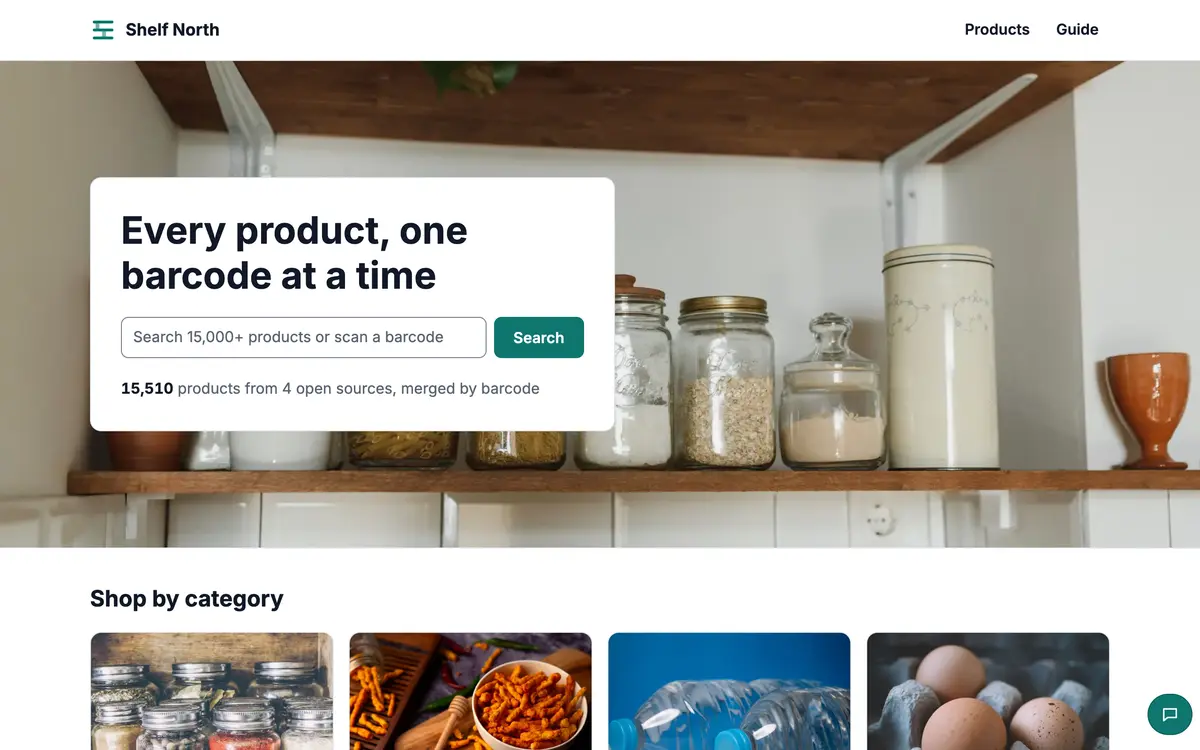
Four product databases merged into one clean catalog of about 15,500 products. Duplicates are merged, doubtful matches go to a person, and WordPress updates every night.
Problem
Catalog and price comparison sites get their product data from several places. Each source spells brands, sizes and categories its own way. The same product shows up three times under slightly different names. Barcodes come in 12 and 13 digit forms, and some are simply wrong. Prices arrive in feed files of different formats.
Most teams fix this by hand in spreadsheets and upload the result to WordPress again. The site is slow to update, full of duplicates, and its filters crawl once it holds thousands of products.
How it helps your business
- One clean catalog instead of four messy lists. More than 17,000 source records became about 15,500 products, with more than 550 duplicates merged and about 360 of those combining two or more databases. The other records wait in the review queue for a person, or were set aside because they had no usable name.
- No silent wrong merges. When a match is doubtful, a person decides. More than 1,100 records are waiting in a review queue instead of being guessed.
- The site updates itself. Every night the catalog is sent to WordPress, and only the products that changed are sent.
- Real prices with history. About 400 products show real store prices, with a chart of how the price moved.
- Filters that stay quick with more than 15,000 products behind them.
- A chat that sticks to your products. It answers only from the catalog and says so when it can't help.
What it does
- Brings in four sources. Each source has its own importer, and all four pass through the same cleanup: barcodes are checked and put in one form, and sizes, units, brands and categories are written one way.
- Matches by barcode. Records with a valid barcode are matched on it. Records without one are compared by name, brand and size. A clear match is merged, a clear miss becomes a new product, and anything in between goes to the review queue.
- Review side by side. The catalog desk shows the doubtful record beside the product it might belong to, field by field. One press chooses Match, Merge as new product or Reject, and the catalog changes right away. It is the same review pattern as my invoice and receipt data entry project.
- Browse and filter. Shoppers filter by category, brand, source and price, and each filter shows how many products it holds. Every filtered list has its own link you can share.
- Product pages that show their sources. Each page lists the photo, brand, size, barcode, where the product came from, and prices by store.
- Price feeds and history. Store prices come from Open Prices. They are published as Google Merchant XML and CSV feeds, one per store chain, then read back every day. Each product with prices gets a price history chart.
- A nightly sync with a run log. Each run records what was created, updated, left unchanged and failed. The first scheduled nightly run sent 87 changes (70 new products and 17 updates), left 15,423 products unchanged and had no failures.
- Ask the catalog. A chat button on every page answers questions from the catalog and links the products it used. Ask about something that isn't in the catalog and it tells you so, the same rule as my website support bot.
Outcome
A live catalog of about 15,500 products, built from more than 17,000 source records, that keeps itself current. You can filter it, open a product with a price chart, work the review queue and read the nightly run log yourself, starting from the guide.
Speed, measured:
- Filtered listing pages under load: 95% of filtered pages loaded within 142 ms with 10 people browsing at once (measured 2026-11-28 through Cloudflare's edge cache)
- Lighthouse on a phone: performance 100 on the home page and 98 on a product page, accessibility 100 on both (mobile, median of 3 runs, measured 2026-11-28)
A closer look
Filter by category, brand, source and price; every filtered list has its own link. A product page shows its sources, licence and prices by store. The review queue: doubtful matches wait for a person to decide. The same catalog on a phone.
How it's built
- One catalog database. Products, source records, prices, the review queue and every run live in Supabase Postgres. Row-level security is on every table, so the public site can read only what it needs to show.
- Sends only what changed. The nightly sync talks to WordPress over its REST API and compares each product with the last copy it sent, so unchanged products are skipped.
- Filters read a prepared table. Filter counts come from an indexed facet table, with an object cache and a page cache in front, instead of being worked out on every visit.
- WordPress the usual way. A block theme, a product post type, and ACF fields kept in code, so the setup can be reviewed and rebuilt.
- Chat tied to the catalog. Each question is matched to products with vector search in Supabase, and the answer is written by Cloudflare Workers AI from those products only.
- Credit where it's due. Every imported record keeps its source and licence, and the data credits are on each product page and on the guide.
Stack
Python and FastAPI for the importers, matching and nightly jobs, Supabase Postgres with pgvector and row-level security, a WordPress block theme with ACF fields in code, Cloudflare Workers AI for the chat, a Cloudflare Worker relay for reading the sources, and a Google Cloud VM.
Want this for your business?
Send a short note on what you're building or the idea you have. I'll reply with questions and a rough plan. It's free, and I'd love to connect and help.
Typical timeline: Quoted per milestone · From $2,500. See MVP and feature builds