
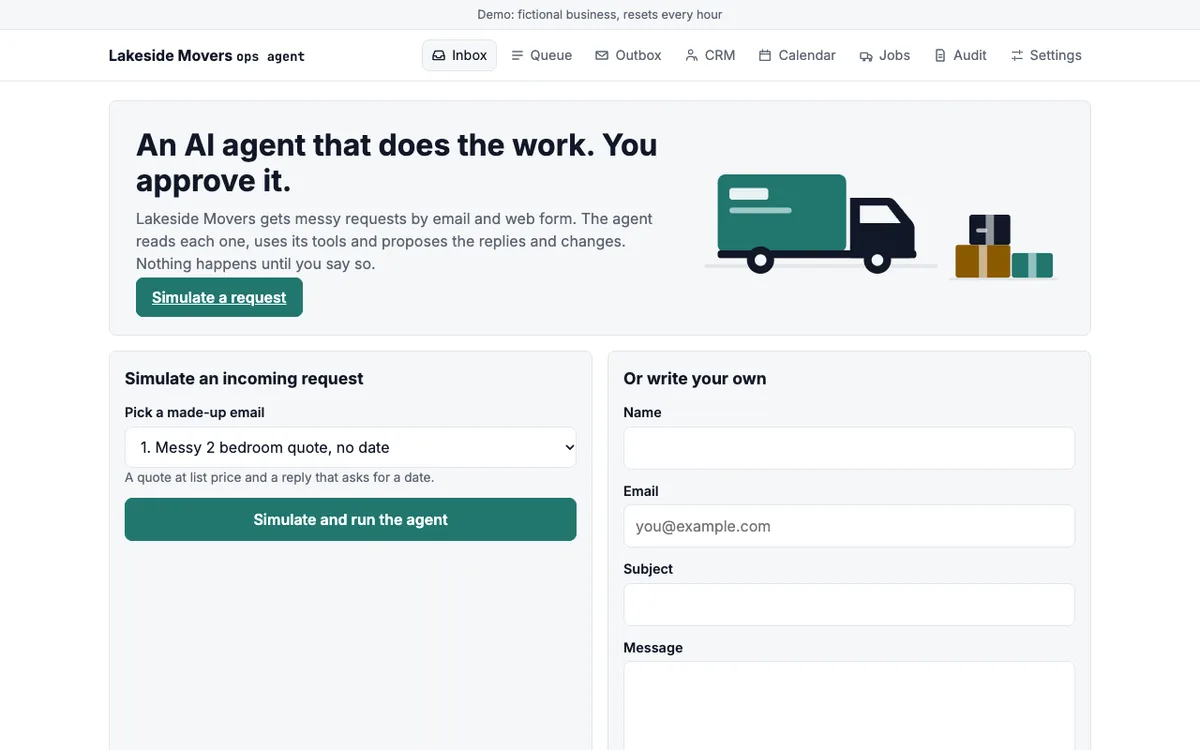
Problem
A small business gets requests all day by email and web form, and they are rarely tidy: "need a quote for a 2 bedroom, maybe next month", "can we move Thursday to the afternoon?", an angry complaint, a question about insurance. Someone has to read each one, check the price list and the calendar, update the job and write back. Most AI helpers either only write drafts or act on their own. A business owner can't trust either with real customers.
How it helps your business
- Requests come to you ready to send. The agent reads each request, checks prices and times, and prepares the reply and the changes.
- You stay in charge. Nothing reaches a customer and nothing changes until you approve it.
- No wrong prices or double bookings. Quotes stay within your price list, and a taken time is never booked twice.
- You know what it costs. Every request shows its estimated cost.
What it does
It runs the back office of Lakeside Movers, a moving company.
- Reads the request. It works out what the customer wants (a quote, a booking change, a complaint or a question) and how sure it is.
- Uses the business's tools. It looks up the price list, checks free times in the calendar, finds the customer in the CRM (the customer list) and opens the job sheet.
- Proposes, never acts alone. It drafts the reply and shows each change as a before and after, such as "Move job J-107 from Thu 8:00 to Thu 14:00". Everything waits in a list for the owner.
- The owner decides in one tap. Approve, edit the reply, or reject. Only then is the email sent or the job changed.
Each run is shown step by step, so the owner can see what the agent looked up and why it proposed what it did.
Safety rules the AI can't get around
The important rules are written in code, not in the AI's instructions, so the AI can't talk its way around them:
- Price limits. Quotes stay within the price list.
- No double booking. If the slot is taken, it proposes the next free one.
- Unsure requests go to a person. When the agent isn't sure, it says so and hands the request to the owner.
- Large refunds and discounts need approval. Above a set amount, the owner must approve, and the amount is shown in the change.
- Trick emails are flagged. An email that tries to give the agent new instructions is marked as suspicious, and nothing is changed.
A full record, with the cost of every request
Every step the agent and the owner took is saved in a log. Each request shows how much AI it used and an estimated cost, so the owner knows what the agent costs to run.
Outcome
A working pattern for the AI features small businesses ask for: an assistant that does real work with real tools, keeps the owner in charge, and has the safety checks written as tested code.